Guides
REVO vs Veeva Vault vs Salesforce Life Sciences Cloud vs IQVIA OCE
A 2026 life sciences CRM guide for comparing enterprise suites, data-driven platforms, and prescription-growth focused commercial software.
Key takeaways
- Enterprise CRM suites are not automatically the best fit for every pharma commercial team.
- The strongest CRM choice depends on implementation speed, CLM costs, AI maturity, data needs, and prescription impact.
- Revosuite is positioned as a focused commercial execution layer for teams that want faster Rx growth workflows without enterprise-suite complexity.
The 2026 life sciences CRM shift
For much of the last decade, pharma CRM strategy was often framed as a narrow choice between a small set of enterprise vendors. That view is now too simple.
The market has changed. Veeva is moving CRM customers toward Vault. Salesforce is building a dedicated Life Sciences Cloud. IQVIA OCE has moved through several strategic chapters around data, Salesforce infrastructure, and commercial orchestration. At the same time, smaller and mid-sized pharma teams are asking a sharper question: does the CRM actually improve prescription growth, or does it mainly log field activity?
This guide compares four paths:
- Veeva Vault CRM for enterprise life sciences standardization.
- Salesforce Life Sciences Cloud for AI-forward, cross-business CRM.
- IQVIA OCE for data-driven commercial orchestration.
- Revosuite powered by Rx-Booster for prescription-growth focused commercial execution.
The goal is not to crown a universal winner. The right answer depends on the size of the team, the complexity of the operating model, the depth of existing vendor relationships, and how quickly the organization needs to turn commercial activity into measurable field impact.
1. Veeva Vault Platform: the enterprise compliance fortress
Veeva Vault CRMOpens in a new window is a life sciences-specific customer relationship management platform built on Veeva's proprietary Vault architecture.
Its strategic value is clear for global life sciences organizations that want CRM, content, medical, regulatory, and quality processes to live inside one controlled enterprise ecosystem. Vault CRM also reflects Veeva's departure from its previous Salesforce-based CRM architecture.

What makes Veeva Vault stand out
- Unified content and data platform: Vault CRM sits close to Veeva applications such as PromoMats, RIM, QualityDocs, and Medical, which can simplify regulated content and approval workflows for teams already inside the Veeva ecosystem.
- Enterprise-grade compliance: The platform is designed for global life sciences requirements, validation processes, change control, and region-specific regulatory needs.
- Global deployment power: Veeva is built for large multi-country rollouts with the governance, documentation, and enterprise controls that top pharma companies expect.
- Deep ecosystem commitment: The same unified ecosystem that creates control can also create lock-in. Teams should be clear about their long-term appetite for a proprietary operating layer.
Ideal for
Global top-tier pharmaceutical companies with large field forces, mature IT organizations, complex multi-country deployment needs, and existing investment in Veeva applications.
Key consideration
Veeva Vault CRM can be more platform than many commercial teams need. Implementation timelines, validation work, internal governance, and ecosystem migration can be significant. Organizations that mainly need stronger sales execution, faster CLM, and cleaner commercial workflows may find the enterprise scope heavier than necessary.
2. Salesforce Life Sciences Cloud: the AI-first generalist
Salesforce Life Sciences CloudOpens in a new window is Salesforce's dedicated life sciences industry platform. It brings pharmaceutical and medtech capabilities onto the broader Salesforce architecture, with customer engagement, AI, automation, and cross-functional data models positioned as the core value.
Its strength is the Salesforce platform itself: a large partner ecosystem, extensibility, analytics tooling, and rapid AI investment through Einstein and Agentforce.

What makes Salesforce Life Sciences Cloud stand out
- AI and automation roadmap: Salesforce is investing heavily in Agentforce for Life SciencesOpens in a new window and life sciences AI capabilities, including agent-assisted workflows for customer engagement.
- Cross-organizational integration: Teams can connect commercial, service, clinical, medical, and other business functions on one Salesforce foundation.
- Extensibility: AppExchange, Salesforce developers, and implementation partners create a large ecosystem for customization.
- General-purpose foundation: The same flexibility can become complexity. Many pharma-specific workflows still require configuration, implementation support, or custom development.
Ideal for
Enterprise and upper mid-market pharma teams already using Salesforce, or organizations that want a highly extensible platform and have the internal resources or partners to shape it around life sciences workflows.
Key consideration
Salesforce Life Sciences Cloud is powerful, but it is not automatically lightweight. Teams should evaluate how much implementation work is required before field users see value. If the commercial team needs practical, prescription-driven workflows quickly, a highly configurable platform can become slower than expected.
3. IQVIA OCE: the data-driven commercial orchestrator
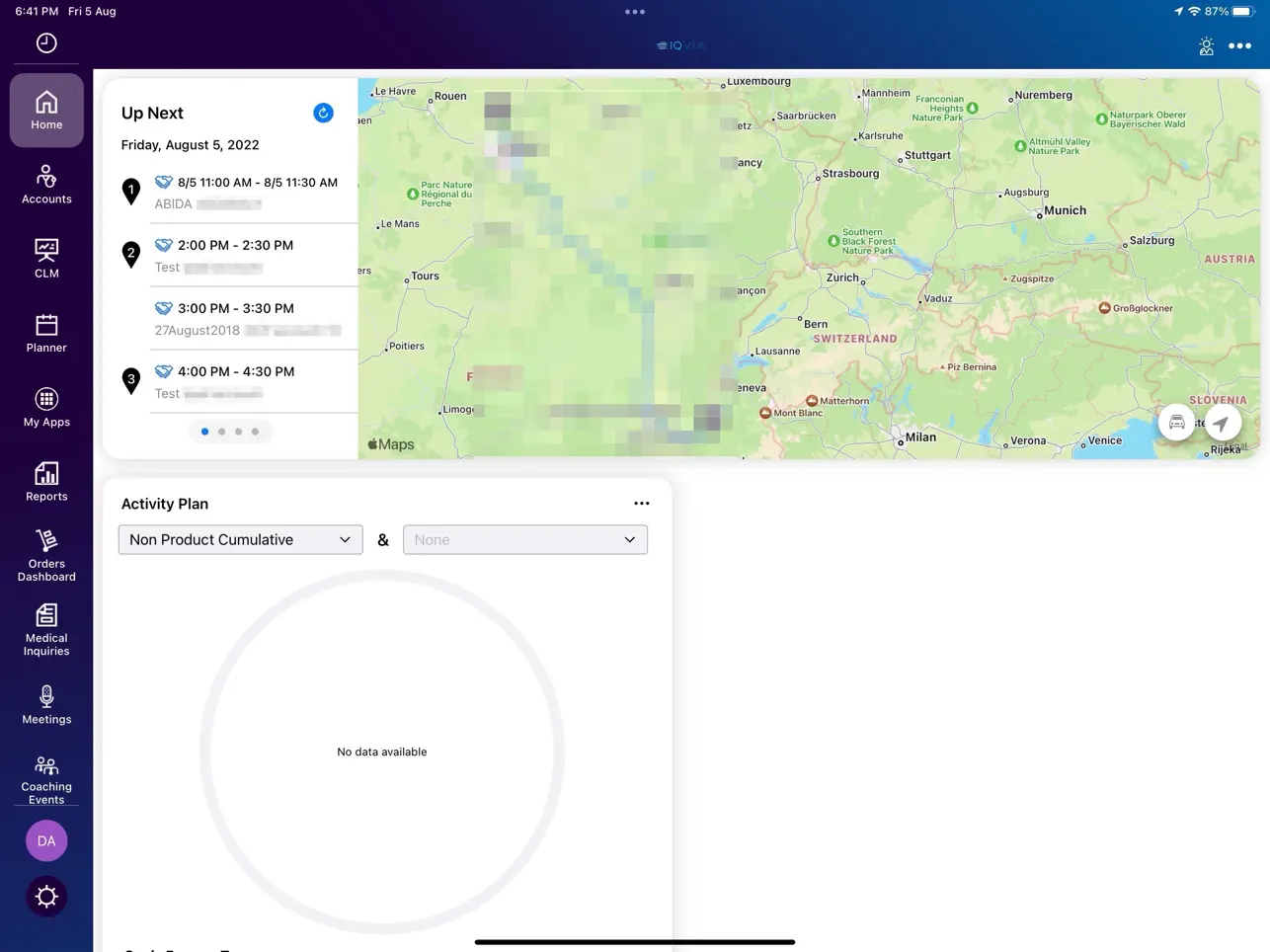
IQVIA OCEOpens in a new window was built around the idea of orchestrated customer engagement: connecting sales, marketing, medical, data, analytics, and services into one coordinated commercial model.
Its strongest differentiator is IQVIA's healthcare data and consulting wrapper. For organizations that already rely on IQVIA data for targeting, prescription analytics, and market intelligence, OCE can feel like a natural extension of the broader orchestrated customer engagementOpens in a new window environment.
What makes IQVIA OCE stand out
- Data integration: IQVIA's data assets, provider intelligence, and prescription analytics can support targeting and measurement.
- Pharma heritage: OCE was designed for life sciences commercial operations and deployed across many markets.
- Services support: IQVIA consulting can help with implementation, change management, and optimization.
- Salesforce foundation: OCE's Salesforce architecture can be familiar to teams with Salesforce experience.
Ideal for
Mid-to-large pharma companies that already depend on IQVIA data, want a technology-plus-data relationship, and value services support around commercial execution.
Key consideration
The data relationship can be both strength and constraint. Teams without a strong IQVIA data strategy may see less differentiated value. Multi-year service commitments and heavier implementation models can also reduce flexibility for teams looking for a lighter commercial workflow layer.
4. Revosuite powered by Rx-Booster: the prescription growth specialist
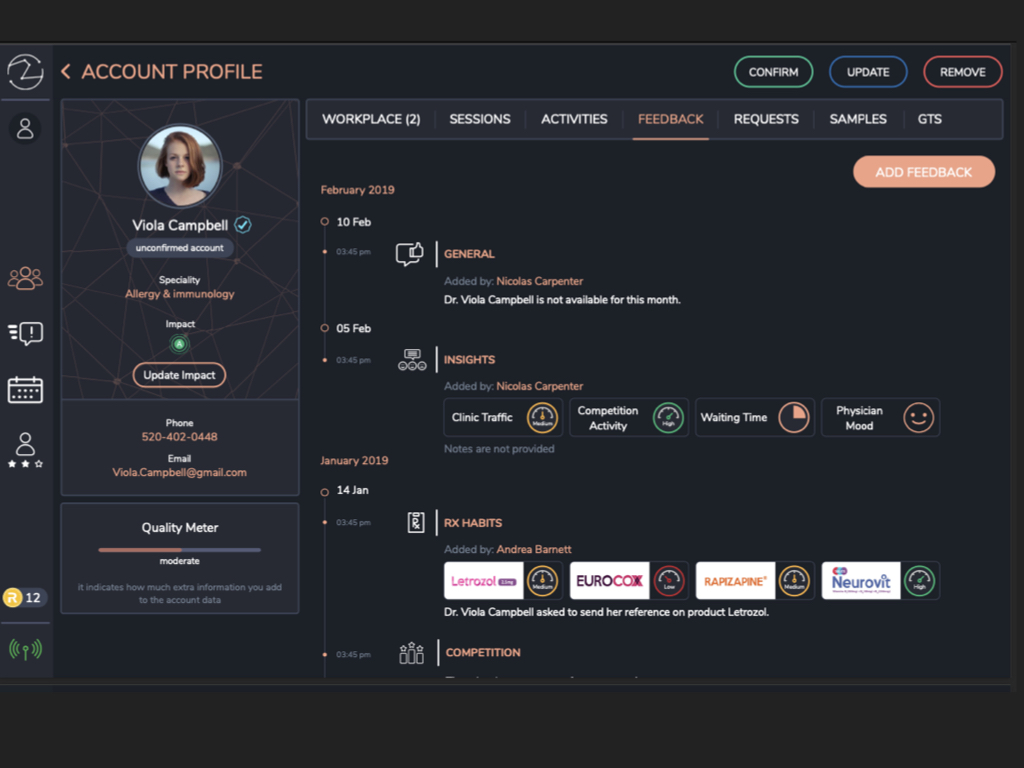
Revosuite is a specialized pharmaceutical commercial platform centered on one principle: CRM should help teams grow prescriptions, not only record activities.
The Rx-Booster module turns static promotional material into interactive, KPI-tracked digital experiences. This connects HCP engagement, content usage, field behavior, and prescription outcomes more directly than traditional call logging.
Unlike broad enterprise suites, Revosuite focuses on pharma and nutraceutical commercial operations. It can run as a pharma-native CRM, or work as an execution layer on top of an existing CRM.
What makes Revosuite stand out
- Prescription-first philosophy: Workflows are designed around field execution, HCP engagement quality, and prescription impact.
- Zero-cost CLM production model: Rx-Booster converts existing PDF brochures into interactive detail aids without the expensive agency model often required by traditional CLM.
- Rapid deployment: Teams can become operational in months, not multi-year rollout cycles.
- Modular pricing: Revosuite is built as a modular commercial suite instead of a forced enterprise bundle.
- Flexible operating model: Teams can use Revosuite alongside an existing CRM or use REVO CRM as the system of record.
Ideal for
Growing pharma and nutraceutical teams that want to scale field execution, improve promotional quality, launch products faster, and connect activities to prescription-driven growth without taking on enterprise-suite complexity.
Key consideration
Revosuite is a commercial specialist, not a mega-suite for R&D, clinical operations, or quality management. It is strongest when the problem is field execution, CLM, approvals, customer governance, campaign rhythm, and Rx growth.
Side-by-side comparison
The matrix below follows the original decision structure: best fit, maturity and industry focus, speed of implementation, drawbacks and limitations, and cost.
| Feature | VeevaVault Platform | SalesforceHealth Cloud | IQViaOCE | RevosuitePowered By Rx-Booster |
|---|---|---|---|---|
| Best for | ||||
| Ideal customer | Global "Top 20" Pharma; With massive internal IT teams and multi-country deployments, and deep regulatory/R&D integration needs. | Enterprises wanting "Agentic AI" & cross-org scale. | Data-heavy teams relying on IQVIA datasets. | Growing teams. aiming to scale prescription-driven revenue while staying aligned with ethical marketing standards and running frequent, multi-product campaigns at speed. |
| Company size | Global Enterprise (1,000+ reps). | Enterprise & Upper Mid-Market (500+ reps). | Mid-to-Large Pharma (200+ reps). | Companies aggressively scaling their field force. Automated workflows standardize onboarding, visual promotion, and marketing feedback, ensuring execution quality improves - not degrades - as teams grow from 20 to 200 reps. |
| Maturity and industry focus | ||||
| Market maturity | Vault CRM was announced in late 2022 and became generally available in April 2024. Considered mature due to Veeva's large existing CRM user base transitioning from the Salesforce-based platform. | New entrant (GA 2024). Built on Salesforce's general-purpose platform with life sciences layers. | Mature product (Launched 2017) built on Salesforce. Future innovation is now part of Salesforce's roadmap. | Established specialist (Founded 2011). Innovation is centered on AI for Rx growth and sales enablement. |
| Industry vertical | Platform for Life Sciences. | General-purpose platform with Life Sciences layers. | Built exclusively for Life Sciences on top of Salesforce platform. | Deep focus. Exclusive focus on Pharmaceuticals & Nutraceuticals. |
| Innovation focus | Compliance-focused. Supports all critical region-specific capabilities and regulatory needs - from Brazil to Japan, Germany and beyond. | Innovation heavily driven by Salesforce's Einstein AI and Agentforce. The new Agentforce features for Life Sciences (Pre-call Agent, Media Agent, Voice Agent) launched in late 2025 as part of their AI strategy. | Core strength is IQVIA's data & analytics pedigree. | AI for Rx Boost. Put the team on the right track to win more Rx while nurturing the company's ethical selling principles. |
| Speed of implementation | ||||
| Time to first value | Very Slow: Multi-year global rollouts. | Moderate: Months to years (ecosystem dependent). | Slow: Heavy data/analytics integration cycles. | Plug & Play. Fully operational within 1-3 months, with historically proven compliance exceeding 70%. |
| Setup complexity | Traditionally longer, complex implementations due to enterprise scale and validation requirements. Migration to new Vault platform adds a layer of consideration. | Implementation speed can vary widely. As a new platform, proven patterns are still emerging, but Salesforce's partner ecosystem enables rapid deployment. | Typically long implementation projects, often bundled with IQVIA's consulting and data services. Current partnership with Salesforce creates uncertainty. | Short implementation cycle. Positioned as a key differentiator, with promised ROI within weeks. |
| Learning curve | Steep, with complex customization. Effective administration requires specialized skills in a "Veeva Salesforce hybrid" language, and the enterprise-grade platform demands significant training and change management. | High, due to a custom-build approach. Success often requires substantial internal staffing and resources to build and maintain industry-specific workflows on the general-purpose platform, leading to a long, costly implementation. | Moderate to High. Tied to ecosystem depth. The learning curve is influenced by the platform's deep integration with IQVIA's proprietary data and analytics services, which adds value but also complexity for users and administrators. | Designed to flatten the curve. Automated, template-driven workflows reduce training time and ensure new reps are productive quickly, making rapid team expansion viable. |
| Drawbacks and limitations | ||||
| Key limitation | High cost and vendor lock-in into a closed ecosystem. | New and unproven in core pharma sales automation. The "jack of all trades" nature can lead to higher customization needs to achieve specialized workflows. | Strategic uncertainty due to the transition to Salesforce. Potential data lock-in with IQVIA's ecosystem. May lack the CRM agility of a pure software player. | Not a mega-suite. More of a specialist tool for pharma commercial operations, not R&D and clinical operations. |
| Not ideal for | Can be overly complex and costly for companies focused purely on sales execution. | Complex workflows. Can't handle sophisticated business processes. | Organizations that don't have IQVIA data integrated into their operations or lack existing relationships with IQVIA's data ecosystem. | Non-commercial purposes. Less suitable for companies needing deep R&D, Clinical, or Quality Management (QMS) modules. |
| Cost | ||||
| Starting price | High and opaque. Veeva does not publish its fee structure; however, industry benchmarks suggest per-user monthly TCO typically reaches the high hundreds, depending on the module mix. | Public premium pricing: - Enterprise: ~$350/user/month - Unlimited: ~$525/user/month - Agentforce AI add-on: ~$750/user/month. | Complex tiered licensing. Often bundled with data and service contracts. Specific pricing is not typically public. | Public, transparent & modular. Core modules like Rx Booster start around $50 per user, while the Approval Workflows Engine begins at $35 per user. Teams combining multiple plug-and-play modules, including CRM capabilities, typically land around the $100 per user range. Enterprise deployments, building on REVO's infrastructure with advanced controls and customization, generally range between $200-$250 per user, depending on operational complexity. |
| Detailing materials (CLM) | Requires content creation for its Vault PromoMats application. While a modular software suite, promotional material production typically relies on specialized, licensed third-party agencies, incurring high per-asset fees. | The platform's model is less defined, but its general-purpose nature suggests promotional content creation would require either internal technical resources or third-party partners, leading to project-based costs. | Similar enterprise model; the platform facilitates content use but does not handle production. Creating compliant HTML detail aids for its ecosystem also necessitates work by expensive external agencies, adding to total cost. | Zero-cost production model. REVO Rx-booster converts static brochures into KPI-tracked, interactive detail aids. Customers routinely publish 100+ intelligent product assets in their first month. |
Beyond the big four
Choosing life sciences CRM is not only a vendor comparison. The decision should also include the operating risks that determine whether the platform will actually improve field performance.
01Legacy generic pharma systemsThe hidden TCO risk often comes from lost field productivity.
Many pharmaceutical organizations still operate on systems built during the data-logging era: platforms designed to track compliance, not drive results.
Legacy systems prioritize call notes, sample submissions, and contact updates. Those tasks add administrative overhead but little direct value to HCP relationships or prescription growth.
Modern platforms should reduce administrative burden through automation. If your system requires more clicks to log a call than to prepare for one, you are optimizing for the wrong outcome.
- Does the platform maximize HCP face time or maximize data entry?
- Are we measuring activity completion or prescription impact?
- What is our true TCO when rep productivity loss is included?
02AI hype vs healthcare impactThe AI slides look similar; field evidence does not.
Every major vendor now promotes agentic AI, LLMs, and digital labor. The important difference is not the vocabulary; it is the specific commercial problem the AI solves.
Many vendors are still in the experiment phase: generic LLM wrappers, unclear use cases, little production history, and no hard evidence of prescription lift or field-force behavior change.
Revosuite built its commercial engine on predictive analytics before agentic AI became a buzzword: identifying high-potential HCPs, forecasting territory performance, and detecting prescription drift.
- Cognito Pulse reads real execution data and explains what changed.
- Cognito Compass uses historical patterns and predictive signals to expose turnover risk, abandoned customers, and better workforce allocation.
- Cognito Coach helps reps with field planning, territory coverage, and coaching actions based on detailing quality.
- Cognito Signal supports FLMs with improvement areas, action plans, and rep notifications.
- Cognito Insight helps marketing analyze material usage, surface under-used messages, and launch HCP surveys where data is silent.
- What specific commercial problem does this solve?
- Can you show prescription data, not demo videos?
- Which pharma teams have deployed this successfully?
If a vendor cannot connect AI to a concrete use case, your data, and your compliance reality, treat the claim with caution.
03Custom build vs best-of-breedCustom can be useful, but its long-term cost is often underestimated.
Some organizations consider building proprietary systems or heavily customizing platforms, especially when they have unique regulatory needs or deep IT resources.
- Ultra-specific regional compliance requirements.
- Unique business models not supported by commercial platforms.
- Existing enterprise architecture requiring deep integration.
- Maintenance when regulations and workflows change.
- Talent dependency and key-person risk.
- Slower innovation than commercial platforms shipping regular updates.
- Five-year TCO including internal FTEs, not just license spend.
For most commercial teams, the smarter path is configurable best-of-breed software for core workflows, with custom development reserved for truly differentiating capabilities.
04CLM and detailingCLM is the operating core of pharma commercial work, not a secondary feature.
Closed-loop marketing is where compliance, content governance, and revenue generation intersect. Yet many CRM evaluations still treat CLM as an add-on.
- Every promotional interaction must be pre-approved, tracked, and auditable.
- Traditional CLM can require expensive agencies for every detail aid.
- Many systems track calls completed without proving which content moved prescriptions.
- Can marketing teams create detail aids without developer skills?
- Does the platform support Medical, Legal, and Regulatory approval workflows?
- Can content engagement be connected to prescription changes?
- Can reps access approved content without field friction?
If your CRM treats CLM as a separate ecosystem, factor in the real cost of production, approval, and measurement.
05Geographic redundancyA tiered strategy reduces vendor concentration risk.
The 2025-2026 period made vendor concentration risk more visible: price changes, migration pressure, shifting terms, and operational dependency.
- Tier 1: enterprise platform for core markets such as the US, EU, and Japan.
- Tier 2: regional or backup platform for emerging markets and faster programs.
- Pilot layer: agile software for new launches before global rollout.
- Pricing leverage against vendor lock-in.
- Better fit for regional requirements and data residency needs.
- Business continuity if the primary platform changes or fails.
- Pilot testing in smaller markets before enterprise standardization.
Do not put all commercial operations in one vendor account. Fit-for-purpose architecture often improves flexibility, risk, and ROI.
How to decide
Use these questions before choosing:
- What is the primary business problem: compliance control, data orchestration, AI extensibility, or prescription growth?
- How fast does the field team need value?
- How much implementation complexity can the organization absorb?
- Is CLM a core workflow or an external production process?
- Does the platform improve coaching, coverage, and execution quality?
- What will the system cost after implementation, content production, add-ons, services, and rep productivity are included?
- Can the platform scale with the team without forcing enterprise complexity too early?
References
- Veeva Vault CRMOpens in a new window
- Veeva Vault CRM migration roadmapOpens in a new window
- Salesforce Life Sciences CloudOpens in a new window
- Salesforce Life Sciences Cloud availability announcementOpens in a new window
- Agentforce for Life SciencesOpens in a new window
- Salesforce Life Sciences pricingOpens in a new window
- IQVIA OCE launch announcementOpens in a new window
- IQVIA orchestrated customer engagement white paperOpens in a new window
- IQVIA vs Veeva CRM comparisonOpens in a new window
- Veeva, IQVIA, and Salesforce CRM comparisonOpens in a new window